Why the Police Report Isn’t the Final Word — Even If the Insurer Pretends It Is
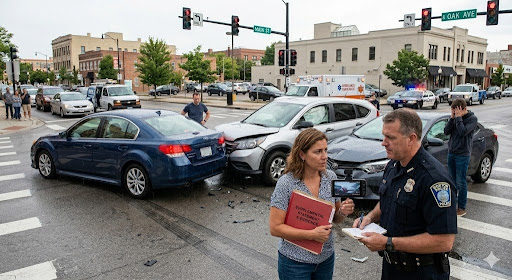
A woman I’ll call Maria came in on a Tuesday afternoon with a manila folder and that particular look I’ve come to recognize — equal parts frustration and self-doubt. She’d been rear-ended at a light on her usual commute, a nothing-special intersection she’d crossed a thousand times. The reporting officer had listed the wrong street name, noted her vehicle color incorrectly, and — the part that really stung — summarized the sequence of events in a way that left out the fact that she’d been fully stopped for nearly eight seconds before impact. The insurance company had already called twice, citing the report as if it were scripture.
She asked me the question I hear constantly: “If I push back, will that make me look like I’m hiding something?”
No. It will not. And the rest of this is for everyone who’s sitting where Maria was sitting.
The Report You Got Is a First Draft, Not a Verdict
Police reports are written under pressure, often within minutes of a chaotic scene, by officers who are managing traffic, interviewing multiple parties, and filling out forms designed for administrative efficiency — not legal precision. Errors happen. Not because officers are careless or dishonest, but because the conditions don’t favor perfect documentation.
What tends to go wrong falls into two distinct categories:
| Error Type | Common Examples | How Correctable? |
|---|---|---|
| Factual errors | Wrong vehicle color, wrong street name, wrong insurance number, wrong direction of travel | Generally straightforward to fix |
| Incomplete narratives | Missing that you were stopped, omitted admission of fault, no mention of road conditions or obstructions | Harder — usually challenged during claims or in court |
Correcting factual errors is the more navigable path. Nolo notes that factual mistakes like vehicle details, insurance coverage, or accident location are the most correctable, while subjective opinions about fault are harder to change through the report itself. Omissions — the officer didn’t note that you’d been stopped, didn’t record the other driver’s admission, didn’t capture the sun glare — don’t make the report dishonest. They make it incomplete. And incomplete is something you can address.
What to Do in the Days Right After the Crash
The window right after an accident matters more than most people realize, and not just for medical reasons. The evidence that will support any future correction or supplemental statement is most available in the first 48 to 72 hours.
Step 1: Get your copy of the report.
You can’t identify what’s wrong until you’ve read it carefully. In Massachusetts, the RMV provides crash report access through its myRMV Online Service Center, or by mail with a completed form, ID copy, and payment sent to RMV Crash Records in Boston. Required identifiers include your driver’s license number, name, date of birth, Social Security number, and email address.
Other states have their own portals. Arizona DPS, for instance, handles this through a separate records process that distinguishes between a Citizen’s Collision Report and a formal copy request — a distinction that actually matters when you’re trying to route a supplemental statement without triggering a whole new claim review.
Step 2: Read it line by line.
Write down every factual detail you can verify or contradict: vehicle descriptions, directions, street names, times, weather, and any statements attributed to you. Then go back to your own evidence.
Step 3: Inventory what you have.
Here’s what counts — and how much weight each type of evidence typically carries:
- Dash cam footage — Highest value. Doesn’t rely on anyone’s recollection, often dispositive on its own.
- Timestamped photos from the scene — Strong, especially for road conditions, vehicle positions, and signage.
- Medical records — Establish nature and timing of injuries; critical when the report minimizes impact.
- Written or recorded admissions from the other driver — Text messages, voicemails, anything in their own words.
- Eyewitness contact information — Follow up quickly. Memories fade faster than people expect.
If you didn’t get photos at the scene, go back to the intersection. Photograph the sight lines, the signage, the road markings. It won’t recreate the moment, but it can support your account of conditions.
Building the Case for a Supplemental Statement
Here’s where people get confused.
A supplemental statement is not a formal legal challenge. It’s not an accusation against the reporting officer. It’s a written account — submitted to the police department that handled the report — that adds your perspective to the official record. Think of it as a footnote that travels with the file.
Most departments accept them. Some have a specific form; others accept a written letter addressed to the records division or the officer’s supervisor. Call the department’s non-emergency line and ask about their process before you write anything.
When you write it, the tone matters as much as the content.
“The report states I was traveling northbound on Elm Street. I was traveling westbound on Oak Avenue” is useful. “The officer got everything wrong and clearly wasn’t paying attention” is not. The goal is to create a documented record of your version — not to win an argument in the parking lot.
Include your supporting evidence as attachments where possible: a photo showing the correct street sign, a screenshot of your dash cam timestamp, a brief written statement from an eyewitness. The supplemental statement without evidence is just your word. With evidence, it becomes a competing account that any reasonable adjuster has to weigh.
One thing worth knowing: the reporting officer may or may not amend the original report based on your submission. Some will, especially for clear factual errors. Others won’t, particularly if the correction would affect their assessment of fault. That’s frustrating — but it doesn’t mean the effort was wasted. The supplemental statement still enters the record, and your insurance company and any attorney you consult will have access to it.
What Happens When You Bring This to the Insurance Company
Let me be honest about something I’ve watched play out too many times.
Insurance adjusters lean on the police report. It’s efficient for them. It’s a third-party document, it has an official seal, and it gives them a defensible basis for their liability determination. When you call to dispute it, the first response is often some version of “well, the report says…”
That’s not the end of the conversation. It’s the beginning of it.
What changes the dynamic is evidence. An adjuster looking at a dash cam clip showing the other vehicle running a light cannot simply point to a report that says “failure to yield” on your part and call it settled. A medical record showing injuries consistent with a high-speed rear impact complicates a report that described the collision as “minor contact.” An eyewitness statement that contradicts the other driver’s account gives the adjuster a reason — and a professional obligation — to look more carefully at fault and liability.
What doesn’t help: calling angry, calling repeatedly without new information, or making vague claims that the report is wrong without being able to say specifically what is wrong and why. Adjusters are not your adversaries by default, but they are busy, and they respond to documentation more than to frustration.
If the insurance company continues to treat the report as the only relevant document after you’ve submitted a supplemental statement and supporting evidence, that’s when the conversation shifts. You’re no longer dealing with an oversight — you’re dealing with a dispute. That may mean requesting a formal review, filing a complaint with your state’s insurance commissioner, or consulting with a boston auto accident lawyer who can assess whether the insurer’s handling of your claim crosses a line.
The Objections I Hear Most Often
“Won’t this make me look guilty of something?”
No. Requesting a copy of your own crash report and submitting a factual correction is a normal, documented part of the claims process. Insurers see supplemental statements regularly. What actually raises flags is inconsistency — saying one thing to the officer, another to the adjuster, and a third in writing. If your account is consistent and supported by evidence, a supplemental statement strengthens your position.
“What if the officer just refuses to change anything?”
That happens. The supplemental statement still matters because it becomes part of the file. If your claim goes to litigation, your attorney will have it. If the insurer’s internal review looks at the file, they’ll see it. The goal isn’t to rewrite the report — it’s to make sure your version exists in writing, with documentation, in the same place the original report lives.
“Is it worth the effort for a minor crash?”
That depends on what “minor” means for your situation. A crash that looks minor on paper can produce soft tissue injuries that don’t fully present for days. A fault determination on a “minor” accident can affect your insurance rates for years. If the report contains errors that affect liability — even on a fender-bender — correcting the record is worth the time it takes to write a clear, documented statement.
A Quick Reference Before You Start
The process, in order:
- Obtain the official crash report
- Read it line by line and note every specific error
- Gather your evidence (dash cam, photos, medical records, witness info)
- Contact the department’s non-emergency line to ask about their supplemental statement process
- Write a factual, specific, and documented correction — no editorializing
- Submit it with evidence attachments
- Bring the full package — original report plus your supplemental — to the insurance company conversation
You don’t need a lawyer to do most of this. You need time, organization, and the willingness to put your account in writing.
You have every right to say that the first version of events isn’t the complete version. That’s not obstruction. That’s not dishonesty. That’s how accurate records get made — by people who were there, who kept their receipts, and who refused to let an incomplete document stand as the final word on what happened to them.
Your account matters. Put it in writing.
